
The human rights crisis in Kroger’s supply chain
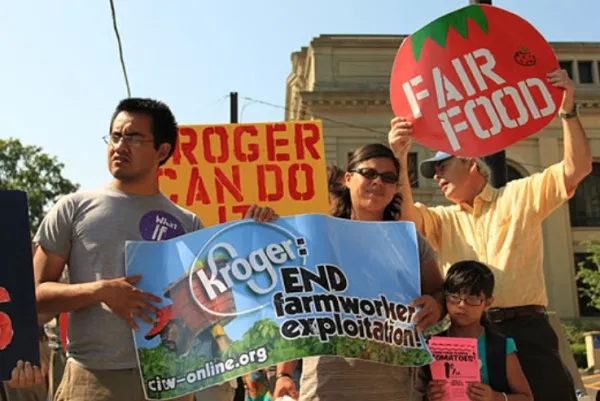
While the Fair Food Program (FFP) continues to change the lives of farmworkers across the U.S. and inspire worker-led human rights initiatives around the world, some of the country’s largest food corporations still refuse to bring the FFP’s proven protections into their own supply chains. Despite years of rallies, marches, shareholder resolutions, letters from customers, and mounting evidence of the program’s unparalleled success in preventing abuse, Kroger refuses to join the FFP.
And while the FFP continues to build a growing track record of prevention, Kroger’s own produce supply chain repeatedly makes headlines for the very abuses the Program has so effectively stopped. Three years ago, after the U.S. Department of Labor identified Kroger as a buyer of watermelons harvested by workers trapped in a brutal forced labor operation, CIW senior staff member and farmworker leader Gerardo Reyes Chavez took to the pages of the Cincinnati Enquirer — Kroger’s hometown paper — with a direct appeal: It is finally time, Kroger, to the human rights crisis in your supply chain and join the Fair Food Program.
Three years later — and yet another forced labor prosecution tied to its supply chain — Kroger still has not acted.
Just weeks ago, another key member of the Moreno trafficking operation, Alexander Villatoro Moreno, was sentenced to 70 months in federal prison. Meanwhile, a separate class-action lawsuit filed by farmworkers in North Carolina has brought new allegations of severe labor abuses at another agricultural operation whose produce, according to publicly available information, was purchased by Kroger.
In the wake of these very latest revelations, Coalition of Immokalee Workers (CIW) co-founder Lucas Benitez has turned to the pages of Kroger’s hometown newspaper, the Cincinnati Enquirer, to launch a renewed call for action. His new op-ed, which we share in full below, picks up where Mr. Chavez’s appeal left off three years ago — with even more evidence of the consequences of Kroger’s continued inaction, and an urgent reminder that the solution has been there all along: Join the Fair Food Program.
Cincinnati Enquirer Op-Ed
Kroger must do more to prevent forced labor | Opinion
Kroger should join the Fair Food Program.
Three years ago, the U.S. Department of Labor identified Cincinnati-based Kroger as a buyer of watermelons harvested by workers trapped in a brutal forced labor operation. At the time, we at the Coalition of Immokalee Workers wrote to Kroger in these pages, urging the grocery giant to join the Fair Food Program, the only human rights enforcement program in agriculture proven to prevent forced labor and other severe abuses before workers are harmed.
Three years later, Kroger still refuses.
Why prevention matters
That refusal matters because just weeks ago, the U.S. Department of Justice announced another conviction in that same forced labor case. Alexander Villatoro Moreno, a key member of the trafficking operation, was extradited from Mexico, pleaded guilty, and was sentenced to 70 months in prison.
Federal prosecutors described a familiar pattern. Workers were recruited from Mexico through fraud, saddled with crushing recruitment debts, stripped of their passports, housed in degrading conditions, threatened with arrest and deportation, and warned that their families back home could be harmed if they resisted.
And the Villatoro case is hardly an isolated incident.
Around the same time the Villatoro case was wrapping up, farmworkers in North Carolina filed a class-action lawsuit alleging wage theft, passport confiscation, illegal recruitment fees, threats, and the denial of drinking water, bathrooms, and medical care during episodes of dangerous heat stress. And, yet again, publicly available information indicates that Kroger purchased produce from the company where the plaintiffs say they worked.
That marks the fourth time in just five years that Kroger has been linked to allegations of forced labor or similarly egregious labor abuses in its produce supply chain.
Enough is enough.
Justice is important. But justice that comes only after workers have endured coercion, violence, and exploitation is not enough.
For those of us who have spent decades fighting modern-day slavery in U.S. agriculture, one lesson has become unmistakably clear: If our goal is to end forced labor, prosecutions alone will never get us there. We must prevent these crimes before workers become victims.
A choice Kroger can make
That is precisely what the Fair Food Program was built to do.